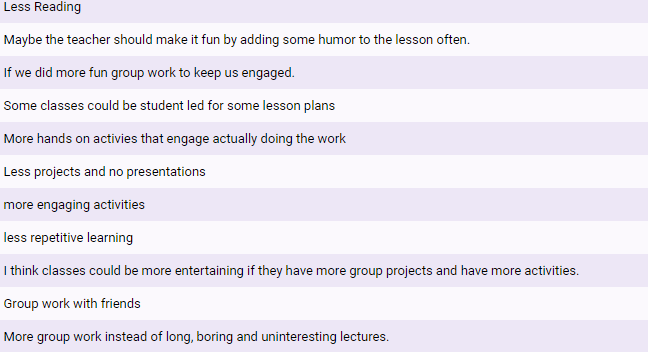
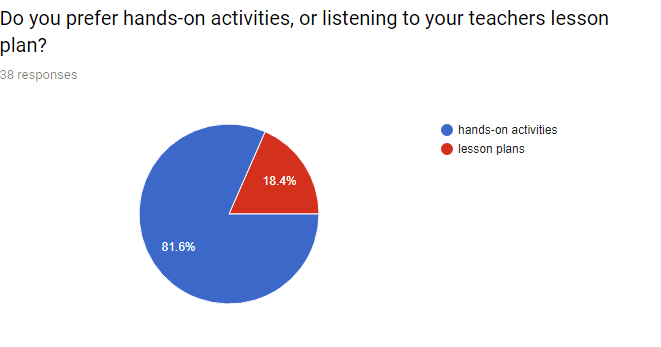
Brain Storm: This idea was bought to life when we noticed that our fellow classmates were bored in certain classes and felt as if the time was moving too slow. While in other classes students were more engaged. We wanted to figure out why. So we decided to to create a survey to see how students feel during classes and if they would like more engaging educational activities to help them learn better and stay more engaged.
Pro’s:
- Less stress
- More engaged
- Increases social skills
- More hands on
- Time consuming
- More practice
- Various oppurtunties
- Fun
- Less paper used
- More brain work
Con’s:
- Distraction
- Time wasted
- Low participation
- More materials/ technology required
- Not much work done
- Gets noisey
- Off task
- Messy
Being hands-on is especially important in the classroom because it allows students to engage in kin-esthetic learning. Studies have shown that kin-esthetic learning, where a student carries out physical activities rather than listening to a lecture, is the most popular type of learning with students – ‘doing’ helps them to gain a better understanding of the material. It allows students to experiment with trial and error, learn from their mistakes, and understand the potential gaps between theory and practice.
But research is now showing that students learn and retain information better when they are given multiple facets. Studies show that students learn best when learning is active, when they are engaged in hands-on classroom games and activities, and involved in what they are learning. Scientists believe that when children use all of their senses it helps the brain create pathways that make it easier and quicker to retain information. In fact, students of all ages can benefit from adding hands-on classroom games and activities to their learning. Whether you’re learning about math or science, history or language arts, hands-on classroom games and activities can be added and adapted to any curriculum.
As students put projects together, create crafts, or use familiar materials in new ways, they’re constructing meaning. “Kids learn through all their senses,” says Ben Mardell, PhD, a researcher with Project Zero at Harvard University, “and they like to touch and manipulate things.” But more than simply moving materials around, hands-on activities activate kids’ brains. According to Cindy Middendorf, educational consultant and author of The Scholastic Differentiated Instruction Plan Book (Scholastic, 2009), between the ages of four and seven, the right side of the brain is developing and learning comes easily through visual and spatial activities.
Hands-on projects obviously engage kids who are tactile or kinesthetic learners, who need movement to learn best. They also engage students who are auditory learners, who talk about what they’re doing, and visual learners, who have the opportunity to see what everyone else is creating. For social learners, the time spent in small group conversation will strengthen their knowledge.
Population: We gave this survey to students in grades 7 through 12. Although a majority of students who took this survey were students to Lindblom a few students from other schools participated in the survey to give their opinion on activities in the classroom. This gave us the opportunity to see the similarities and differences of different schools, students and how they feel about what’s happening in the classroom and what could make it better.
OBSERVATION
On January 18, one of our members observed a boy in her Geometry class. This boy walked in late, and already seemed disinterested. He walked in and said, “I should’ve ditched this class, its so boring”. I also sit next to this boy, and by observing him, I saw a lack of interest as he listened to our teacher go on and on. He even briefly fell asleep for about 10 minutes. However, we did an engaging hands-on activity later in the class and I noticed a significant change. He was actually up, and doing his work, intrigued by his work. I noted this change, and came to a conclusion. This student was initially bored, but once we begun a hands on activity, his attitude significantly changed.
INTERVIEWS
interview 1: They personally think their Tuesday schedule is more boring. Classes could be better, if there were more moving activities that, “gets energy going”. Spends 50% of the day bored. Prefers student led lessons. More fun activities that pertain to the lesson, instead of listening to a presentation.
interview 2: They personally believe their Tuesday schedule is a lot less interesting than their Monday schedule. Classes could be better, if there were more moving activities, like “scavenger hunts around the school”. Spends majority of the day like 90%, uninterested. Prefers teacher led lessons, Believes that more games, helps their mind process difficult information easier.
interview 3: They think that their Tuesday schedule is less fun. Classes could be better, if there were more moving around. Usually bored more than half of the day, 60%. Prefers lessons led by students/peers. Believes that games/educational activities would make learning process more efficient.









 Nailah's Life